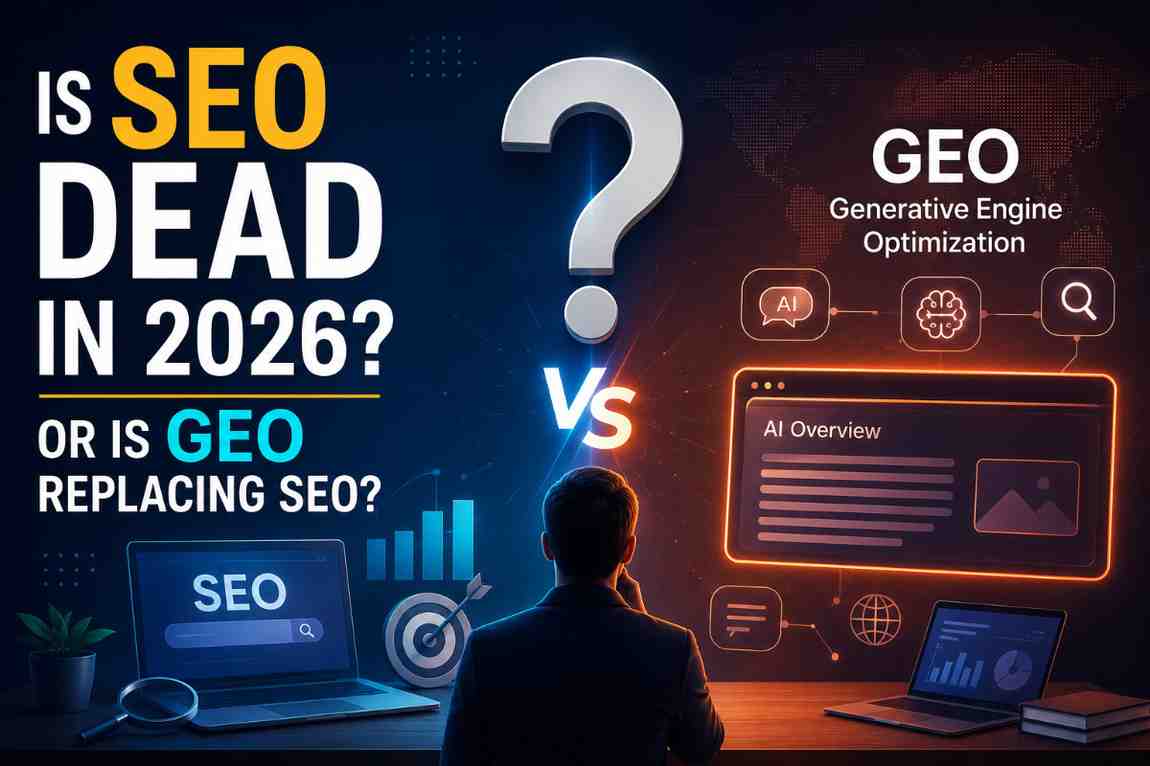
Is SEO Dead in 2026? Or Is GEO Replacing SEO?
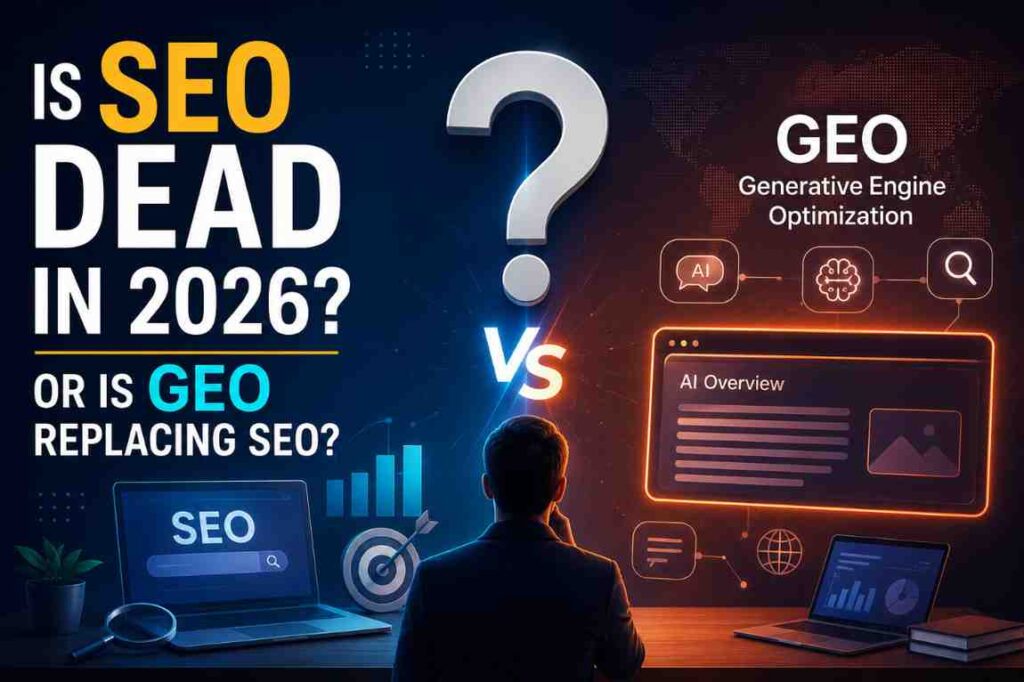
SEO vs GEO in 2026 has become one of the most important discussions in digital marketing as AI-powered search platforms continue to reshape how businesses earn online visibility.
Back in 2026, talk about it came up once more – this time pushed forward by how fast AI-driven search tools grew. As people began relying more on ChatGPT, Gemini, Perplexity, or smart search outputs for information, a real concern started bubbling among company leaders: Is this the moment traditional methods start fading? Each new query typed without visiting a website added weight to that thought
When machines reply fast, why bother tuning web pages? Maybe old tricks fade if smart tools fill gaps. Speed changes what matters online. Pages once fought for clicks – now answers pop up without clicking. Could be, getting found shifts when knowing beats searching.
Far from it, actually – SEO still matters.
Now things are shifting quicker than before in SEO. Not disappearing – just growing beyond old limits, spilling into something different: Generative Engine Optimization, or GEO.
Soon, knowing how SEO connects with GEO will matter more for companies aiming to stay seen on the web. Over time, mixing these two shapes how people find a business online.
SEO vs GEO in 2026: What Is the Difference?
Even so, goals set SEO vs GEO in 2026 despite some common traits.
Traditional SEO focuses on keywords rankings and backlinks
- Keyword optimization
- Search rankings
- Technical website performance
- Backlink acquisition
- User experience
- Search engine crawling and indexing
GEO Focuses On:
- Content authority
- Structured information
- Clear factual answers
- Entity recognition
- Brand mentions across the web
- AI citation opportunities
One way works only if paired with another by 2026. Still, each part needs the other to matter.
Looking past old ranking systems can open doors in AI-powered search spaces. Not every company sees it, yet the shift is already pulling attention elsewhere.
Still, companies skipping basic SEO work won’t gain the trust needed to show up in AI results.
Why Some Believe SEO No Longer Matters
Change hit digital marketing hard lately. Lately, shifts piled up fast across the field. Big moves reshaped how things work behind screens. Over time, old methods faded while new ones stepped forward. What stayed constant was motion – constant movement steering efforts elsewhere.
Right off the bat, Google shows summaries made by artificial intelligence right inside search pages. Answers pop up instantly, so people often skip visiting actual sites altogether. Meanwhile, smart helpers powered by AI handle info needs for huge numbers of folks every day.
Now people often find answers without ever leaving the search page. That change marks what some label the age of zero-click searches.
A single query replaces endless tabs, scattered searches. Answers come pulled together, not hunted across pages. One question – then clarity appears, stitched neatly. Pages once clicked through now sit unused. The answer arrives without jumping from site to site. Information gathers itself, ready. Reading dozens of results feels unnecessary. A clear reply shows up first. Hunting ends early.
For example:
- “What is the best CRM for small businesses?”
- “How can I improve local SEO?”
- “Which digital marketing strategy works best in 2026?”
Finding information fast – some tools now skip the usual web searches altogether. Responses come straight out of the box, no clicking around needed. One stop gives what used to take five. Jumping between pages? Not always necessary anymore. Answers land right where you ask.
Now things look different. Traffic shifts left people asking if old-school SEO still matters at all.
Truth bends in ways you might not expect.
Out there, artificial intelligence pulls responses straight from what it finds online. Should those websites vanish or turn shallow, the answers spit out by machines would crumble just as fast.
Put simply, artificial intelligence in search isn’t replacing content. Instead, it makes strong, trustworthy writing matter more than ever.
What Is GEO?
Out there, where artificial intelligence digs through info, Generative Engine Optimization shapes how material shows up. It tweaks writing so smart systems notice it, grasp what it means, then pull it when needed. Instead of just aiming at traditional searches, this works behind the scenes with chatbots and reply machines. The goal? To make sure answers include your words when bots build responses.
Most older SEO methods aim to get pages higher up in search results.
What GEO does is boost how often your work shows up when AI talks about topics. One way it works? By making sure machines notice what you’ve made. Think of it like this: instead of shouting into a crowd, your words get handed directly to those who listen. Sometimes they repeat them. Other times they pass them along. The point isn’t just visibility – it’s being picked. Machines choose content. GEO helps yours stand out when decisions happen behind the scenes.
Now it’s not just about climbing Google’s list. How artificial intelligence understands facts matters just as much. A shift happens when machines start pulling answers differently. What once worked for search engines needs rethinking. Seeing beyond old ranking tricks becomes necessary. Machines read data in new ways. Adjusting to that change is part of staying visible. Relevance isn’t judged only by clicks anymore.
The goal shifts from:
“How do I rank 1 on Google?”
to
“How do I become a trusted source that AI systems use when generating answers?”
Change like this matters. Still, SEO stays right where it was before – right in place.
From there, something new takes shape.
SEO remains relevant in 2026
Even with smarter machines around, Google still handles countless searches daily.
Searching continues around:
- Local services
- Products
- Reviews
- Tutorials
- Business information
- Industry solutions
These days, people still look things up – just differently. How they search shifted, yet the act remains.
A company searching for nearby help might turn to a voice helper first. Yet most still click through sites prior to choosing who to pay. One step leads online, even when advice comes from machines.
Potential clients continue needing to:
- Read reviews
- Compare pricing
- View portfolios
- Check case studies
- Contact businesses directly
Still matters – sites build trust online, so SEO sticks around.
Most companies go unnoticed if they lack visibility on the web, whether people use standard searches or artificial intelligence tools. A weak digital footprint means fading into the background where neither algorithms nor users can find them.
The Growth of Trust Driven Marketing
One of the biggest shifts in 2026 is the growing importance of authority.
These days, search tools plus artificial intelligence tend to favor reliable origins.
Out of nowhere, generic material made without real skill just does not work well anymore.
Folks who’ve been around the block a few times tend to stand out now. Knowing your field inside out helps. Showing what you’ve actually done makes a difference too.
This is exactly what drives companies to pour resources into
- Thought leadership content
- Original research
- Case studies
- Expert insights
- Industry-specific resources
A fresh perspective often comes from someone certified digital marketer, sharing useful thoughts now and then – this builds credibility with algorithms far better than pages filled with copy-paste material. While one focuses on quality updates, the other floods feeds without purpose, losing favor over time.
Now it’s clear: influence stands out where others follow. Power shows up when few expect it. Strength grows quietly, then shifts everything.
AI search and SEO changes
Nowadays, Google keeps changing its search tools using artificial intelligence. This means companies need to pay closer attention to how their material shows up online. As noted in Google’s Search documentation, focusing on useful content made for humans still leads to better results over time.
Businesses adapting changes
Most clever companies aren’t stuck picking one over the other. Some skip the debate entirely – focusing on results instead. A few blend tactics without naming them. Others adjust quietly, depending on what works today. Not every winner follows a single path.
One piece fits inside the other now. The two separate parts move together like they were always meant to. A shared path replaces old divisions. What was split now works under one plan.
1. Create Helpful Expert Level Content
Clear facts get noticed by artificial intelligence more than anything else. What matters most? Precision without clutter. Useful details stand out, simply because they help people. Accuracy shapes how machines judge value. Information that makes sense rises to the top. Straightforward answers beat clever phrasing every time. Machines notice what teaches them something real.
Avoid writing articles solely for keywords.
Solving actual user issues matters most. What users face daily drives better solutions. Real needs shape useful outcomes. When challenges get clear attention, results improve. Problems guide progress without distraction.
Start by tackling frequent doubts people bring up. Mix in real-life moments that show how things work on the ground. Slip in clear takeaways folks can actually use right away.
2. Strengthen Brand Signals
AI platforms increasingly recognize brands as entities.
When trusted sites talk about your company, visibility grows. Listings in directories help too. Being in print or online articles adds weight. Even shares on social media count. Each mention builds presence bit by bit. Seen more places? That means a deeper mark online.
Consistency matters.
3. Improve Content Structure
Putting ideas in order helps machines make sense of words. A clear layout guides artificial brains smoothly through text.
Use:
- Clear headings
- Short paragraphs
- Bullet points
- FAQ sections
- Logical content organization
Better flow for people plus clearer structure for systems.
4. Build Expertise Around Key Topics
A single post on any subject just does not cut it anymore.
Businesses should develop comprehensive content clusters around their expertise.
For example, a company offering digital marketing expert services should publish content covering:
- SEO
- AI search optimization
- Content marketing
- Google Ads
- Conversion optimization
- Analytics
This demonstrates depth of knowledge.
Understanding SEO vs GEO in 2026 helps businesses build a strategy that works across both traditional search engines and AI-driven discovery platforms.
5. Real Experience Builds Trust
Stories from actual situations now matter more than ever.
Real skill stands out when machines scan for answers. Not every written word carries weight with algorithms. True understanding shows through in how ideas connect. What matters gets noticed without needing labels. Depth speaks louder than structure ever could.
Showing clear outcomes helps companies stand out. What gets seen usually wins attention. Proof of success opens doors quietly. Performance speaks when words fall short. Real numbers pull focus without shouting. Work that shows impact stays noticed.
The discussion around SEO vs GEO in 2026 should not be viewed as a battle between two strategies.